
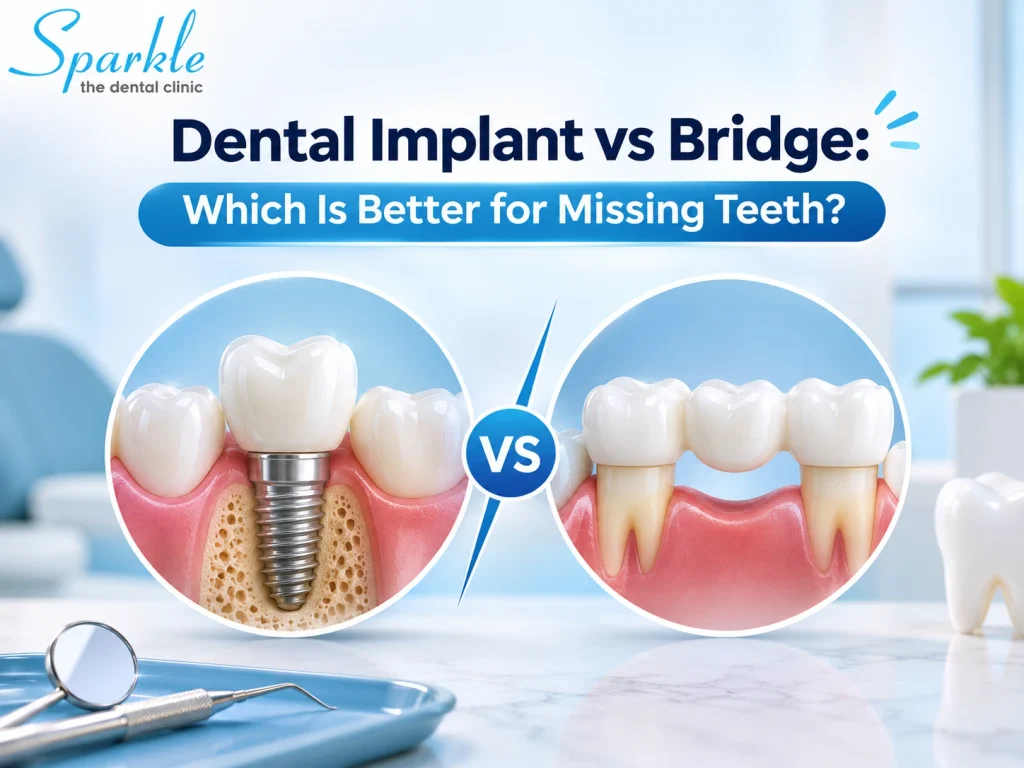
Dental implant vs bridge is the first question most patients ask after losing a tooth. It’s tempting to ignore a gap, especially at the back of the mouth where nobody sees it. But teeth are team players. When one goes missing, the others start to shift.
Neighbouring teeth slowly tilt into the empty space. The tooth above or below, now with nothing to bite against, can drift out of position. Chewing gets uneven, which puts extra load on the remaining teeth. And there’s the jawbone. Bone stays strong because tooth roots stimulate it every time you chew. Without a root there, the bone in that spot gradually thins out, and this can begin within months.
So the real question isn’t whether to replace the tooth. It’s how. That’s where the choice between an implant and a bridge comes in.
What Is a Dental Implant?
A dental implant is a small titanium post that’s placed into the jawbone, where it acts as an artificial tooth root. Over a few months, the bone bonds with the post in a process called osseointegration. Once that’s done, a connector piece (the abutment) and a custom-made crown are attached on top.
The result is a tooth that’s anchored in bone, much like your natural one. It doesn’t rely on the teeth beside it for support, which is its biggest selling point.
Implants can replace a single tooth, several teeth, or even a full arch when combined with other prosthetic work. If you’d like to see how the process works at our clinic, you can read about our dental implants treatment in more detail.
The Upsides
- Feels and functions close to a natural tooth
- Protects the jawbone by keeping it stimulated
- Doesn’t involve filing down healthy neighbouring teeth
- Can last for decades with good care
The Trade-offs
- Higher upfront cost
- Takes longer, since healing time is built in
- Needs a minor surgical procedure
- Requires enough healthy bone and healthy gums
What Is a Dental Bridge?
A dental bridge does exactly what the name suggests: it bridges the gap. A false tooth (called a pontic) is held in place by crowns fitted onto the teeth on either side of the space. Those two supporting teeth are known as abutment teeth.
To make room for the crowns, the dentist has to reshape those neighbouring teeth by removing some enamel. Once that’s done, an impression is taken, the bridge is made in a lab, and it’s cemented in place a couple of weeks later.
Bridges have been used for a very long time, and they remain a reliable choice for the right patient. You can find an overview of the process on our dental crowns and bridges treatment page.
The Upsides
- Lower upfront cost
- Faster treatment, often completed in a few weeks
- No surgery required
- Suitable when the jawbone isn’t strong enough for an implant
The Trade-offs
- Healthy neighbouring teeth have to be reshaped
- Doesn’t stop bone loss under the gap
- Usually needs replacing after some years
- Can be harder to clean underneath
Dental Implant vs Bridge: Side-by-Side Comparison
Let’s put the two treatments next to each other and look at the factors that matter most.
1. How Long Each One Lasts
This is where the two differ the most. A well-placed implant, looked after properly, can last twenty years or longer, and many last a lifetime. The crown on top may need replacing at some point because of normal wear, but the post itself often stays put.
A bridge generally lasts somewhere between ten and fifteen years, sometimes less if the supporting teeth develop decay or gum problems. Since the bridge depends on those teeth, a problem with one of them affects the whole structure.
2. Effect on Jawbone Health
An implant sits in the bone, so it keeps that area active and helps hold the bone’s shape. A bridge sits on top of the gum. The pontic touches the gum, but nothing below it stimulates the bone, so the ridge can slowly shrink. Over time, that can leave a small gap or a hollow look under the false tooth.
3. Impact on Neighbouring Teeth
An implant stands alone. Your adjacent teeth stay untouched. A bridge needs those teeth to be crowned, which means removing healthy enamel that can’t grow back. If those teeth are already heavily filled or weak, that’s less of a concern. If they’re perfectly healthy, many dentists would rather not touch them.
4. Look and Feel
Both options can be colour-matched and shaped so that people won’t notice. Implants tend to feel more natural when you bite and chew, because the force travels down into the bone the way it does with a real tooth. Bridges feel stable too, but some patients say they’re more aware of the false tooth, especially in the first few weeks.
5. Treatment Time
A bridge is the quicker route. Most patients are finished within two to three weeks. An implant usually takes several months from start to finish, because the bone needs time to heal around the post. In some suitable cases, a temporary tooth can be fitted early so you’re not walking around with a visible gap.
6. Cost
In the short term, a bridge costs less. An implant costs more upfront. But it’s worth looking at the long game. If a bridge needs replacing once or twice over the years, or if the supporting teeth later need treatment, the gap in total cost narrows. Your dentist can give you a clear estimate for both so you can compare properly.
7. Cleaning and Maintenance
An implant is brushed and flossed much like a natural tooth. A bridge needs a bit more effort, since food and plaque collect under the false tooth. You’ll need floss threaders or a water flosser to keep that area clean. If it’s neglected, the supporting teeth can decay or the gums can become inflamed.
Who Is a Good Candidate for an Implant?
Implants work best when a few conditions are met:
- You have enough jawbone, or you’re open to a bone graft to build it up
- Your gums are healthy
- You’re generally in good health and can heal well after a minor procedure
- You’re able to commit to regular check-ups and good oral hygiene
Some factors need extra care, including smoking, uncontrolled diabetes, and untreated gum infection. These don’t automatically rule out an implant, but they do need to be managed first. If gum problems are part of the picture, it’s worth having them sorted before anything else; our gum disease treatment can help get things stable.
Who Is a Good Candidate for a Bridge?
A bridge may be the sensible choice if:
- The teeth next to the gap already have large fillings or crowns
- Bone loss makes an implant difficult, and you’d rather avoid grafting
- You want a quicker solution
- Your budget is limited at the moment
- Surgery isn’t suitable for you for health reasons
There’s no shame in choosing a bridge. For many people, it’s the practical answer, and it can serve them well for years.
What About the Extraction Step?
If the damaged tooth is still in your mouth, it may need to be removed first. How and when that’s done can affect the final result. In some cases, an implant can be planned soon after removal; in others, the area needs time to heal. A careful tooth extraction that preserves as much bone as possible makes the next step easier, whichever option you choose.
Recovery and Aftercare
After an implant, mild swelling and tenderness for a few days is normal, and most people manage it with the medicines the dentist suggests. Soft food for the first few days, gentle brushing around the area, and keeping up with follow-up visits all help the healing process. Full integration with the bone takes a few months.
After a bridge, the teeth may feel sensitive for a short while, as they’ve been reshaped. That settles for most people within a couple of weeks. Cleaning under the bridge becomes a daily habit from day one.
For both, regular check-ups matter. A professional cleaning every six months and a quick review of the restoration catch small problems before they grow.
Common Myths, Cleared Up
“Implants are always painful.” The procedure is done under local anaesthesia, and most people describe the aftermath as manageable discomfort rather than serious pain.
“A bridge is just as good in every case.” It’s a good option in the right situation, but it doesn’t protect the bone the way an implant does.
“I’m too old for an implant.” Age on its own isn’t the deciding factor. Overall health and bone condition matter more.
“Implants can be rejected like an organ transplant.” Titanium is well tolerated by the body. Implant failure is uncommon and is usually linked to infection, poor hygiene or smoking, rather than rejection in the usual sense.
How to Decide: Questions Worth Asking Yourself
Before your consultation, it helps to think through a few things:
- How long do I want this solution to last?
- Are the teeth beside the gap healthy or already heavily restored?
- Can I plan for a treatment that takes a few months?
- What’s my comfort level with a minor surgical procedure?
- Am I able to keep up with daily cleaning and regular visits?
There’s no universal right answer. A proper examination, with X-rays and a look at your bone and gums, will tell you far more than any article can. And if you’re missing several teeth, a wider plan such as full mouth rehabilitation may be worth discussing.
Conclusion: Dental Implant vs Bridge, Choosing What Fits You
So, which side wins the dental implant vs bridge debate? It depends on you. Implants offer long-term durability, protect the jawbone and leave neighbouring teeth alone, but they cost more and take longer. Bridges are quicker, need no surgery and cost less at the start, though they involve reshaping healthy teeth and may need replacing down the line.
What matters most is getting an honest assessment before you decide. At Sparkle the Dental Clinic in Kalyani Nagar, Pune, you get a personalised consultation where your bone health, gum condition and goals are looked at together, and both options are explained plainly so you can choose with confidence. The clinic has been providing dental care in Kalyani Nagar since 2001, follows careful sterilisation practices with individually sealed instruments, and is listed as an ISO 9000:2008 certified clinic.
Your care is led by Dr. Manoj Nair, an Endodontist and Implantologist. He completed his BDS at Nair Hospital Dental College, Mumbai, and his MDS in Conservative Dentistry and Endodontics at Government Dental College, Mumbai. He has more than 5,000 clinical hours of experience, has taught as faculty at Government Dental College Mumbai and Bharati Vidyapeeth Dental College Pune, is registered with the Maharashtra State Dental Council, and is a member of the Indian Dental Association. He works alongside Dr. Shilpa Nair, an Inman Certified Dental Surgeon with BDS from Nair Hospital Dental College, Mumbai.
Ready to talk through your options? Contact Sparkle the Dental Clinic to book a consultation and find out whether an implant or a bridge suits your smile.
Frequently Asked Questions
1. Which is better, a dental implant or a bridge?
Neither is better for everyone. Implants generally last longer and protect the jawbone, while bridges are faster and cost less upfront. Your bone health, neighbouring teeth, budget and timeline all play a part, so a dental examination is the best way to decide.
2. How long does a dental implant last compared to a bridge?
With good care, an implant can last twenty years or more, and often a lifetime. A bridge typically lasts around ten to fifteen years, depending on the health of the supporting teeth and how well it’s cleaned.
3. Is getting an implant more painful than getting a bridge?
Both are done under local anaesthesia. An implant involves a minor surgical step, so you may have some swelling and tenderness for a few days. A bridge usually causes only short-term sensitivity. Most patients manage either with simple medication.
4. Can I get an implant if I’ve been missing a tooth for years?
Often, yes. But bone may have shrunk during that time. Your dentist will check your bone volume with X-rays, and a bone graft might be suggested if more support is needed.
5. Does a bridge damage the teeth next to it?
The supporting teeth have to be reshaped to hold the crowns, which removes some healthy enamel. That’s a permanent change, and those teeth also carry extra load afterwards, so keeping them clean is important.
6. How soon can I eat normally after each treatment?
With a bridge, most people eat normally within a day or two once it’s cemented. With an implant, you’ll stick to softer food for a few days and avoid heavy chewing on that side until the dentist confirms healing is on track.
7. Is a dental implant worth the higher cost?
For many patients, yes, especially younger patients or those with healthy bone, since the implant may outlast several bridges. For others, a bridge makes better sense. A clear cost comparison from your dentist helps you weigh it up.

Dr. Manoj Nair (Endodontist & Implantologist)

Dr. Shilpa Nair (Inman Certified Dental Surgeon)
Dr. Shilpa Nair completed her graduation from Nair Hospital Dental College, Mumbai in 1997. She gained clinical experience under experienced private dental practitioners before establishing Sparkle Dental Clinic in Kalyani Nagar.
Her clinical approach places importance on hygiene, patient care and keeping up with developments in dentistry. She is also certified in Inman Aligner from the UK, supporting the clinic’s orthodontic and cosmetic treatment offerings.
Qualifications
- BDS, Nair Hospital Dental College, Mumbai
- Inman Certified Dental Surgeon
- Inman Aligner certification from the UK