
Dental Implants Treatment in Kalyani Nagar
What Is a Dental Implant?
Dental implants treatment in Kalyani Nagar replaces a missing tooth root with a titanium post that supports a crown, bridge or denture. Dr. Manoj Nair, an Implantologist with 26 years of experience, plans and places implants at Sparkle The Dental Clinic, Kalyani Nagar.
Unlike a bridge or denture, which rests on or attaches to neighbouring teeth or the gum, an implant replaces the tooth root itself, integrating with the jawbone rather than sitting on top of it. This is what allows it to support a crown independently, without relying on the teeth next to the gap. Replacing the root also helps preserve the jawbone underneath, which naturally begins to shrink once a tooth root is no longer present.
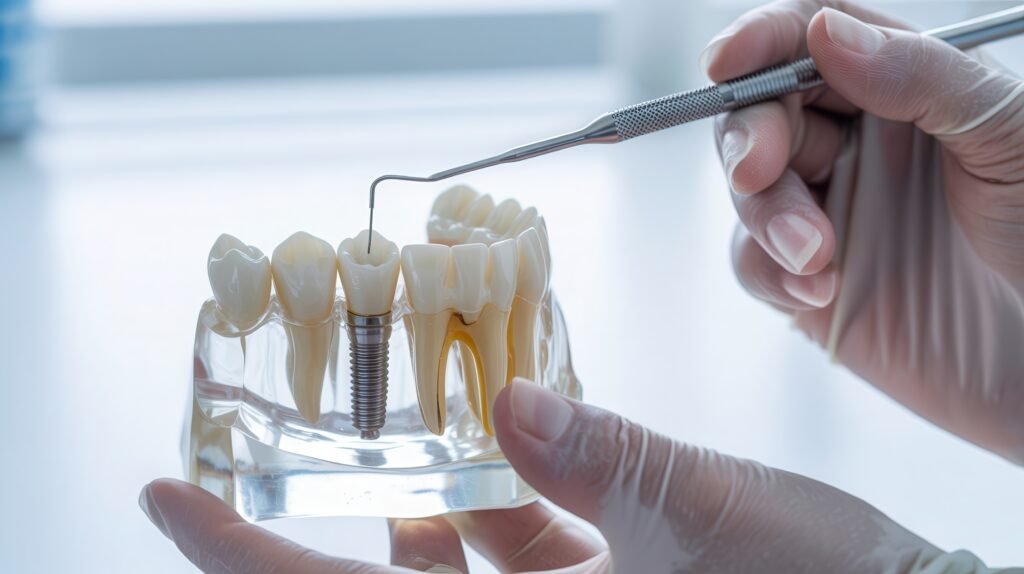
How Dental Implants Work
The implant post
A titanium post placed into the jawbone, taking the place of the natural tooth root
The abutment
A small connector piece attached to the implant post once healing is complete
The crown
The visible, tooth-shaped restoration attached to the abutment, matched to the surrounding teeth in shade and shape
These three parts work together as a single functioning unit, which is why implant treatment happens in stages rather than as a single appointment.
When Are Dental Implants Recommended?
A single missing tooth, where an implant avoids altering the healthy teeth on either side, unlike a bridge
Multiple missing teeth, where implants can support a bridge without resting the load on remaining natural teeth
A full arch of missing teeth, where implants can anchor a fixed or removable denture more securely than gum-supported dentures alone
A tooth lost to extraction, once the socket has healed enough to support an implant
Types of Implant-Supported Restorations
| Single-Tooth Implant | Implant-Supported Bridge |
|---|---|
| Replaces one missing tooth | Replaces several missing teeth in a row |
| One implant post, one crown | Two or more implant posts anchor a multi-tooth bridge |
| Does not affect neighbouring natural teeth | Reduces load on remaining natural teeth compared to a tooth-supported bridge |
| Suited to isolated gaps | Suited to a few adjacent missing teeth |
An implant-supported denture extends the same principle further: two or more implant posts anchor a removable or fixed denture, offering more stability than a conventional denture resting on the gum alone and suiting extensive tooth loss across an arch. Which option fits depends on how many teeth are missing, their position and the condition of the surrounding bone, assessed through examination and imaging rather than assumed from the gap alone.
Who Is a Good Candidate for Dental Implants
Patients with one or more missing teeth and generally good oral health
Patients with adequate jawbone density to support an implant post, confirmed through imaging
Patients who want a fixed replacement rather than a removable one
Patients who have healed from a recent extraction, once the socket is ready to support an implant
Who May Need Additional Preparation First
Patients with reduced bone density, who may need a bone graft before an implant can be placed securely
Patients who smoke, since smoking measurably slows healing and raises the risk of implant failure
Patients with uncontrolled diabetes, since healing and infection risk are affected by blood sugar control
Patients with active gum disease, which is treated first, since it affects the bone and tissue the implant depends on
None of these rule out implant treatment outright. They typically mean an additional preparation step before the implant itself is placed.
Bone Grafting for Dental Implants
A bone graft adds material to the jaw where natural bone has thinned, most often after a tooth has been missing for a long time or was lost due to gum disease. The graft needs time to integrate with the existing bone, typically several months, before an implant can be placed on top of it. This adds to the overall timeline but is a well-established, routine step rather than a sign that implant treatment is not possible.
The Dental Implant Procedure at Sparkle The Dental Clinic
Consultation and imaging
An X-ray or scan assesses bone density and plans the exact implant position
Implant placement
The titanium post is placed into the jawbone under local anaesthesia
Healing period
The bone fuses to the implant post over a period of weeks to months, a process called osseointegration
Abutment placement
Once healing is confirmed, the connector piece is attached to the implant
Crown fitting
The final crown is placed and checked for fit, shade and bite
What to Expect Immediately After Implant Surgery
Mild swelling and bruising around the implant site is common for the first two to three days. Most patients manage discomfort with the prescribed medication and are back to normal daily activity within a day or two, though strenuous exercise is usually paused for about a week. Soft foods are recommended in the first few days while the site settles, gradually returning to a normal diet as healing progresses.
Bone Grafting for Dental Implants
A bone graft adds material to the jaw where natural bone has thinned, most often after a tooth has been missing for a long time or was lost due to gum disease. The graft needs time to integrate with the existing bone, typically several months, before an implant can be placed on top of it. This adds to the overall timeline but is a well-established, routine step rather than a sign that implant treatment is not possible.
Implants vs Bridges vs Dentures
An implant replaces the tooth root and does not rely on neighbouring teeth for support, unlike a traditional bridge, which needs the adjacent teeth reshaped to anchor it. A denture rests on the gum and is removable, which some patients prefer for cost or simplicity, though it does not stop the same bone loss that an implant helps prevent. None of the three is universally correct. The choice depends on the number of teeth missing, bone condition, budget and how a patient weighs a fixed solution against a removable or tooth-supported one.
Caring for Dental Implants
Brush and floss around the implant crown just as you would a natural tooth
Attend regular check-ups, so the clinic can monitor the implant and surrounding gum over time
Avoid smoking during healing, since it is one of the strongest risk factors for implant failure
Wear a night guard if you grind your teeth, since excessive force can affect the implant over time
Report any looseness or discomfort promptly, rather than waiting for the next routine visit
Why Choose Sparkle The Dental Clinic for Dental Implants in Kalyani Nagar?
Dr. Manoj Nair is an Endodontist and Implantologist with 26 years of experience, holding an MDS in Conservative Dentistry and Endodontics from Government Dental College and Hospital, Mumbai. Implant placement is a specific area of his training, not a general add-on to routine dentistry. On Practo, 97 percent of 150 reviewing patients recommend his care.
Because the same clinic handles extraction, bone assessment and implant placement, a patient whose tooth needs to be removed before an implant can be placed does not need to coordinate between separate practices for the two stages.
FAQs
Frequently Asked Questions
Including healing time, the full process commonly takes three to six months from implant placement to final crown, though this varies by site and individual healing.
Local anaesthesia keeps the placement procedure itself comfortable. Some soreness and swelling for a few days afterward is normal and usually manageable with prescribed medication.
A bone graft can build up the site before implant placement. This adds time to the overall process but is a routine part of implant planning when needed.
With good oral hygiene and regular check-ups, implants commonly last well over a decade. The implant post itself often lasts a lifetime, though the crown may need replacement over time due to normal wear.
Sometimes, depending on the condition of the socket and surrounding bone. In many cases, a healing period is recommended first, which is assessed individually rather than applied as a fixed rule.
Cost depends on the number of implants needed, whether a bone graft is required and the type of restoration involved. This is discussed during the consultation once imaging and assessment are complete.
Book an Appointment With Dr. Manoj Nair – Dentist in Kalyani Nagar
Looking for personalized dental care in Kalyani Nagar? Dr. Manoj Nair at Sparkle Dental Clinic offers dental care backed by postgraduate education in Conservative Dentistry and Endodontics, clinical experience, academic teaching experience and ongoing professional development.
Whether you are seeking an evaluation for a dental concern, endodontic care, implant-related consultation or preventive dental guidance, a consultation can help determine the appropriate treatment approach for your individual needs.