
Cavity Treatment for Children in Kalyani Nagar
What Is Cavity Treatment for Children?
Cavity treatment for children in Kalyani Nagar addresses decay in baby and permanent teeth using fillings or, for extensively decayed baby molars, stainless steel crowns. Dr. Manoj Nair and Dr. Shilpa Nair treat childhood cavities at Sparkle The Dental Clinic, Kalyani Nagar.
Treating a cavity in a child’s tooth is not simply a smaller version of adult filling treatment. Baby teeth have thinner enamel, decay can progress faster and the range of appropriate treatment includes options, such as stainless steel crowns, that are not typically used in adult dentistry. Cavity treatment mechanics for adults are covered on the Dental Fillings Treatment page; this page focuses on what changes when the patient is a child.
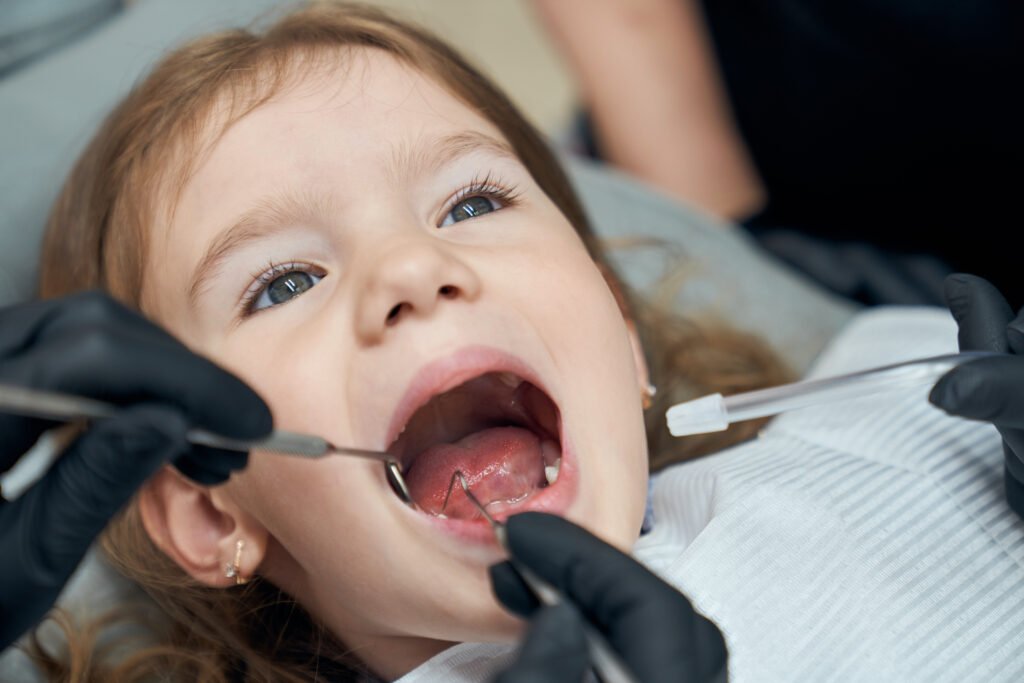
Why Baby Tooth Cavities Need Prompt Treatment
Decay progresses faster in baby teeth
Since the enamel and dentin layers are thinner than in permanent teeth
An untreated cavity can reach the nerve sooner
Than the equivalent decay would in an adult tooth, leading to pain or infection
Infection in a baby tooth can affect the permanent tooth
Developing directly beneath it
A baby tooth lost early to decay
Can allow neighbouring teeth to shift into the space, crowding the permanent tooth meant to erupt there later
Pain from an untreated cavity
Affects a child’s eating, sleep and concentration well before the tooth is due to fall out naturally
Treatment Options for Children's Cavities
Composite (Tooth-Coloured) Fillings
Suited to smaller cavities in both baby and permanent teeth, matching the natural tooth shade.
Glass Ionomer Cement (GIC) Fillings
Release fluoride over time and are often preferred for baby teeth or cavities between teeth, where their properties suit the situation well.
Stainless Steel Crowns
Used for baby molars with more extensive decay, where a filling would not hold up to the remaining time the tooth has left in the mouth; these cover the whole tooth and are a standard, well-established pediatric option rather than a last resort.
Pulp Therapy, in Deeper Cases
When decay has reached closer to the nerve of a baby tooth, a procedure similar in principle to a root canal but adapted for baby teeth may be needed before a crown or filling is placed.
Which option fits depends on the cavity’s size, location and how much healthy tooth structure remains, assessed by examination and X-ray rather than assumed from the tooth’s age alone. Two children with what looks like a similar cavity from a parent’s view can end up with different treatment plans once the examination confirms the specific case.
Cavity Treatment by Age
Toddlers and Preschoolers (Around 1 to 5)
Only baby teeth are present. Cavities are often linked to bottle or sippy cup habits, particularly overnight. Because these teeth still have several years of use ahead, stainless steel crowns are more commonly considered here for molars with significant decay.
School Age With Mixed Teeth (Around 6 to 12)
Both baby and permanent teeth are present at once, so treatment depends on which tooth is affected. A cavity in a newly erupted permanent molar is generally treated with a filling similar to the adult approach, while a baby tooth cavity still has the full range of options, including a crown, depending on severity.
Pre-Teens and Teens (12 and Older)
Most or all teeth are permanent, so cavity treatment looks closer to the adult approach detailed on the Dental Fillings Treatment page, typically a straightforward filling rather than a crown.
Age is a useful general guide, but the specific tooth and its condition, not the child’s age alone, determines the actual treatment plan.
Why Stainless Steel Crowns Are Sometimes Used Instead of Fillings
A large cavity in a baby molar can leave too little healthy tooth structure for a filling to hold securely, particularly on a tooth that still has significant chewing work ahead of it before it falls out naturally. A stainless steel crown covers the whole tooth, protecting it fully rather than relying on a filling to hold in a weakened structure. This is a standard, well-studied option in pediatric dentistry, not an aggressive or unusual step. It is usually faster to place than a large filling would be to shape and finish.
Signs Your Child May Have a Cavity
Complaining of tooth pain
Particularly with hot, cold or sweet foods
Visible white, brown or black spots
On a tooth
A visible hole or pit
In a tooth
Avoiding chewing on one side
Of the mouth
Bad breath
That does not resolve with brushing
Early cavities are often painless, which is why routine check-ups, detailed on the Children’s Dental Check-up page, catch many cavities before a child notices any symptoms at all, often at the stage where treatment is simplest.
How Signs Show Up Differently by Age
Toddlers and preschoolers
Often cannot describe pain clearly. Watch for refusing certain foods, crying during meals, pulling at the face or jaw or a sudden reluctance to brush a specific area rather than a direct complaint. A pattern of decay across the upper front teeth in this age group is often linked to prolonged bottle or sippy cup use and is worth flagging at a check-up
School-age children with mixed teeth
Can usually point to or describe a specific tooth, but may still downplay discomfort to avoid a dental visit, so a described symptom is worth taking at face value rather than assuming exaggeration
Pre-teens and teens
Typically describe symptoms similarly to adults, including specific triggers like cold drinks or biting down, which makes their own report a more reliable guide than it is for a younger child
Symptoms That Need Urgent Attention
Facial or gum swelling, which can indicate the infection has spread beyond the tooth itself
Fever alongside tooth pain, suggesting a more significant infection rather than a straightforward cavity
Severe, persistent pain that does not ease with age-appropriate over-the-counter pain relief
A visible bump or pimple on the gum near the affected tooth, which can indicate an abscess
Difficulty swallowing or fully opening the mouth
These go beyond what a routine check-up appointment is meant to address and are worth same-day or next-available contact with the clinic rather than waiting for the next scheduled visit. The signs listed earlier in this section point to a cavity worth having examined soon; these symptoms point to something that should not wait.
The Cavity Treatment Procedure for Children
Examination and X-Ray
Confirms the cavity's size and depth and whether a filling, crown or pulp therapy fits the case.
Explaining the Process
The process is explained to the child in simple terms appropriate to their age, before starting.
Local Anaesthesia
Used to keep the tooth numb, with a gentle, unhurried approach to the injection itself.
Removing the Decay
The decayed portion of the tooth is cleared out.
Placing the Filling or Crown
The chosen material is placed and shaped, or a pre-formed stainless steel crown is fitted and cemented.
Checking the Bite
The restoration is checked against the opposite teeth so it feels comfortable when the child bites down.
Managing Anxiety During Children's Cavity Treatment
Clear, age-appropriate explanations of each step before it happens, avoiding surprising the child mid-procedure
A patient pace, allowing breaks if a child needs a moment rather than pushing straight through
Distraction and reassurance during the procedure itself
Positive reinforcement afterward, building comfort with future visits rather than ending on a difficult note
Parents involved in the conversation about what to expect, so they can reinforce the same calm framing at home beforehand
Caring for a Child's Tooth After Cavity Treatment
Mild sensitivity for a day or two is common after a filling or crown and usually settles on its own
Avoid very hard or sticky foods on the treated tooth for the first day
Continue normal brushing and flossing, including the treated tooth, rather than avoiding it
Watch for a bite that feels high or uneven and mention it at a follow-up if the child seems to be favouring one side
Keep routine check-ups on schedule, since treating one cavity does not reduce the value of catching the next one early
Why Choose Sparkle for Your Child's Cavity Treatment?
Cavity treatment for children at Sparkle The Dental Clinic is planned around what actually preserves the tooth for the time it has left in the mouth, whether that means a filling or a stainless steel crown, rather than defaulting to one option regardless of the case. Dr. Manoj Nair and Dr. Shilpa Nair explain the reasoning to parents before treatment, so the choice between a filling and a crown is understood rather than simply announced. On Practo, 97 percent of 150 reviewing patients recommend Dr. Manoj Nair’s care.
Typical Cost Range for Children's Cavity Treatment (Industry Estimate)
| Treatment | Estimated Cost (Pune Market) |
|---|---|
| Composite or GIC filling (milk or permanent tooth) | Roughly ₹600 to ₹2,500 per tooth, depending on cavity size and material |
| Stainless steel crown | Roughly ₹2,000 to ₹15,000 per tooth, with wide variation between clinics |
| Pulp therapy | Not consistently quoted across public sources; treated as a case-by-case cost confirmed at examination |
This range exists precisely because cost depends on the individual tooth and case, which is why Sparkle discusses actual pricing only after the examination and X-ray, rather than quoting a number sight unseen.
FAQs
Frequently Asked Questions
Yes, in almost all cases. Untreated decay can cause pain and infection well before the tooth is due to fall out. It can also affect the permanent tooth developing underneath it.
It is generally a similar length of appointment. In some cases it is faster than placing and shaping a large filling. It is a standard option, not an escalation to something more serious.
It is visible as a silver-coloured cap on the treated tooth, most often used on back molars that are less visible when a child smiles. Tooth-coloured crown options exist in some cases, discussed at the consultation if relevant.
Watch for eating changes, chewing only on one side, irritability around mealtimes or reluctance to have that side of the mouth touched. A check-up can confirm what a child may not be able to describe clearly themselves.
Cost depends on the treatment needed, whether a filling, GIC restoration or stainless steel crown. This is discussed once the examination and X-ray confirm the appropriate option.
Book an Appointment With Dr. Manoj Nair – Dentist in Kalyani Nagar
Looking for personalized dental care in Kalyani Nagar? Dr. Manoj Nair at Sparkle Dental Clinic offers dental care backed by postgraduate education in Conservative Dentistry and Endodontics, clinical experience, academic teaching experience and ongoing professional development.
Whether you are seeking an evaluation for a dental concern, endodontic care, implant-related consultation or preventive dental guidance, a consultation can help determine the appropriate treatment approach for your individual needs.